
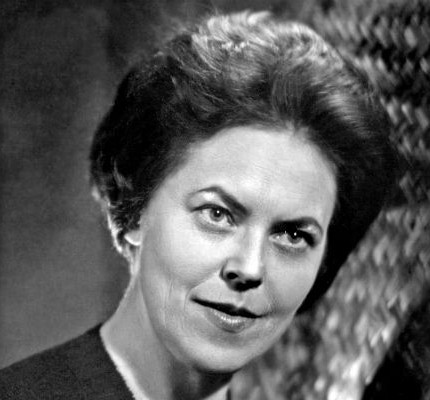
Elga Īgenberga
(10.02.1921 - 28.11.2003 )
Composer and pianist Elga Īgenberga, the only female amongst the pioneers of Latvian popular music, began her career in this genre in the second half of the 1950s. Her brilliant breakthrough was the “Waltz” dance number written for ballerina Velta Vilciņa in 1955, but it soon turned out to that composing songs was Īgenberga’s true calling. Her first songs – “Rīgas bulvāri” (The Boulevards of Riga), “Varbūt” (Maybe) and “Vecais tilts” (The Old Bridge) – immediately attracted attention, especially after having been included in the Rīgas estrādes orķestris (Riga Popular/Variety Orchestra) repertoire and recorded for radio. Listeners quickly took to the distinctly melodic style of her music, which was highlighted in performances by some of the era’s best singers, including Valentīna Butāne, Edgars Zveja and Arnolds Liniņš, who together with the sisters Lolita and Regīna Vambute made Īgenberga’s “Cauri pilsētai” (Through the City, 1961) into an eternal hit. Īgenberga composed many songs for the singer Jānis Zābers and opera soloist Laima Andersone-Silāre. She also wrote popular songs for children in collaboration with actress Vera Singajevska.
Īgenberga wrote song cycles, the operetta Annele (Little Anne), the children’s review Šurum-burums (Hullabaloo), the musical plays Ziņģu lustes (Song Fun), Septiņas vecmeitas (Seven Spinsters) and Čaukstenes (Gossips) and also directed several vocal ensembles (Rīga, Triole, etc.).
For many years (1947–1988) she played accompaniments and improvisations on Rīgas Radio live morning broadcasts, for the first ten years rising at five-thirty every morning to get to the studio on time. It was precisely on these busy mornings that she perfected her improvisation skills, which she famously demonstrated in her solo concerts. Her stage partners, who were some of the most popular singers of the day, called her a one-person orchestra thanks to her great skill as a concertmaster, knowing how to fill any pause and smoothing over mistakes by soloists; even the lack of a score caused her no problems, because she would simply put to use her virtuoso improvisation skills to deliver a wonderful performance.
Īgenberga’s characteristic expression “Johhaidī! Lai dzīvo Latvija!” (Criminy! Long live Latvia!) succinctly characterised her personality as well as the spirited, optimistic mood of her music. It does not contain dramatic, tragic characters, psychological analysis or philosophical revelation; instead, it is more often light and sincere, democratic in expression, sometimes emotionally moving and naïve. However, listeners could not imagine how much time, thought and work went into the creation of her seemingly simple and pleasant-sounding melodies; Īgenberga polished and refined her work down to the very last detail and was very self-critical and demanding of herself.