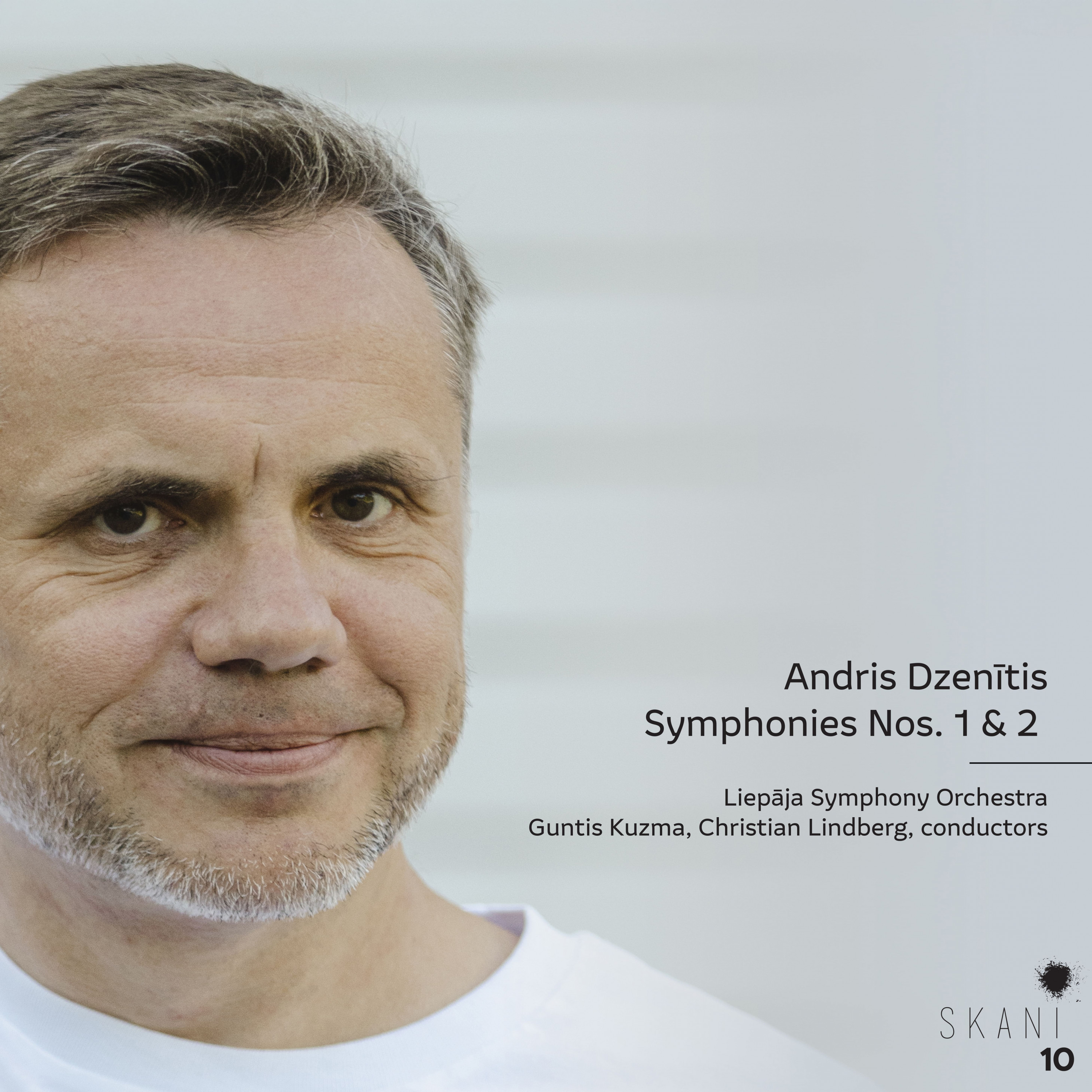
Interessante Pseudo-Symphonien aus Lettland
Der lettische Komponist Andris Dzenītis ist hierzulande noch kaum bekannt. In seiner Heimat Lettland gehört er aber schon seit den 1990er-Jahren zu den wichtigsten Stimmen in der neuen symphonischen Musik des kleinen Lands mit der großen Musiktradition.
Nun hat das lettische Label SKANI ein Album mit drei Orchesterwerken des Komponisten aus den Jahren 2017 bis 2024 vorgelegt. Darunter befinden sich zwei einsätzige „Symphonien“ und ein Stück namens „The Lonely Pine Tree“, welches ich am ehesten als Symphonische Dichtung einstufen würde, der Komponist selbst spricht von einer „Fantasie“.
Die Werke sind auf der Aufnahme nicht chronologisch angeordnet. Es beginnt mit der Symphonie Nr. 1 von 2017. Im Beiheft zur CD erfahren wir ausführliche Hintergründe zum Werk, geschrieben vom Komponisten selbst. Zwar ist das alles sehr interessant zu lesen, jedoch hätte man sich vor allem eine Stellungnahme dazu gewünscht, warum Dzenītis hier von einer „Symphonie“ spricht, denn mit einer Symphonie nach klassischer Sonatenhauptsatzform hat sein Stück natürlich rein gar nichts zu tun. Nicht einmal mit den stark „aufgebohrten“ Symphoniekonzepten von z.B. Sibelius oder Schostakowitsch kommt man hier weiter. Im Prinzip handelt es sich also einfach um groß besetzte Orchesterwerke ohne Solisten.
Nimmt man nun noch die Erläuterungen des Komponisten hinzu, der aussagt, dass das Werk Emotionen in einer Welt widerspiegelt, die von Schnelllebigkeit, Unruhe, sozialem Auseinanderdriften und dem weiter beschleunigenden Effekt der digitalen Medien geprägt ist, wird man doch schnell gewahr, dass es sich hier ebenfalls eher um eine Symphonische Dichtung handelt als um eine Symphonie.
Die Musik ist interessant und bewegt sich entlang einer Traditionslinie, die mit dem Sinfonischen Spätstil von Sibelius begann: Statt thematischer Entwicklungen, gibt es – wenn man so will – langsame, musikalische „Kontinentalverschiebungen“. In jüngerer Zeit könnte man als Vergleich am ehesten wohl Lepo Sumera und Axel Borup-Jørgensen heranziehen, und in der Tat klingt Dzenītis‘ „Symphonie“ wie eine Art Mischung aus Sumeras dritter Symphonie und Borup-Jørgensens Monumentalwerk „Marin“. Wer sich damit anfreunden kann, wird sicherlich auch an Dzenītis‘ erster Symphonie Gefallen finden.
Auf dem Album geht es weiter mit „The Lonely Pine Tree“ aus dem Jahr 2024, das vom Stil her ganz anders daherkommt als die aufgewühlte erste Symphonie. Das Stück eröffnet lieblich, beinahe spätromantisch, und man fühlt sich plötzlich eher an Dvořáks „Symphonie aus der Neuen Welt“ erinnert, als an Sumera und Borup-Jørgensen. Die Erklärung finden wir wieder im Booklet: Anscheinend handelt es sich hier um eine Fantasie über ein Fragment eines Werks des lettischen Komponisten Emīls Dārziņš, der anscheinend vor allem für seine lyrisch-sakrale Chormusik bekannt war und zwischen 1875 bis 1910 lebte. Das passt also ins Bild. Während die Musik fast rein spätromantisch beginnt, wird der Stil nach einer langen Ruhephase ab etwa Minute sechs wieder expressiver und es hält die „musikalische Tektonik“, Einzug, die wir schon von der ersten Symphonie her kannten. Mir gefallen dieses Konzept und überhaupt das gesamte Stück sehr gut.
Die sogenannte Symphonie Nr. 2 aus dem Jahr 2021 beginnt mit viel Geknatter und macht gleich klar, dass wir uns von der Romantik wieder in die unmittelbare Gegenwart begeben. Laut Notizen des Komponisten geht es in dem Werk um reine Abstraktion: Dauer, Klangfarbe, Raumwirkung. Geschrieben inmitten der Coronakrise reflektiert die Komposition eine generelle Zeit der Unsicherheit, aber wohl auch eine Zeit persönlicher Krisen und Sackgassen.
Ich finde das Werk insgesamt sehr viel überzeugender als die Symphonie Nr. 1. Man merkt, dass Dzenītis durch den Kompositionsprozess an der Ersten gelernt hat und anscheinend genau wusste, wie er seine Zweite nun angehen wollte. Die gesamte Komposition wirkt gut durchdacht und macht den Eindruck einer handwerklich reifen Arbeit. Der Ähnlichkeit mit Sumeras Werk ist noch stärker spürbar als in der Ersten, dazu gesellt sich diesmal eine Reminiszenz an repetitiv arbeitende Komponisten hinzu, vielleicht würden einem da Colin McPhee in den Sinn kommen oder Lou Donaldson.
Ein großes Kompliment gebührt dem ausgezeichnet aufspielenden Liepāja Symphony Orchestra unter der Leitung von Guntis Kuzma bei den Symphonien und Christian Lindberg bei „The Lonely Pine Tree“, dies, zumal es sich teilweise um Live-Aufnahmen handelt. Das anspruchsvolle Repertoire ist bei dem Orchester wirklich in besten Händen. Da auch vonseiten Klangqualität und Produktgestaltung und -Qualität nur Positives zu berichten ist, kann man nur eine Empfehlung aussprechen. Die Voraussetzung ist allerdings, dass man sich mit der etwas eigenwilligen Musiksprache von Andris Dzenītis anfreunden kann.
René Brinkmann (13.11.2025), "Klassikhören"
Rated ★★★★★.
Born in 1978, Andris Dzenitis is widely regarded as one of the most talented and creative Latvian composers of his generation. His works are characterised by expressive, colourful music that conveys energy through clusters of sound rather than fast-paced gestures.
In addition, they offer emotional moments that seethe with heat or appear meditatively contemplative, thus offering a wide range of expressive stimuli. Nature and spirituality also play a role. His works display a language that is both contemporary and romantic in tone. This includes Dzenitis exploring tonal and modal possibilities for new spatiality, sphericity, and timbres in already familiar systems.
He attaches great importance to everyone being able to freely interpret audible information such as music, regardless of what the composer had in mind. That is why he does not always explain the content of his works in detail. For Symphony No. 1, translated as ‘Love is Stronger,’ he does at least give some clues that he was concerned about the impact humans have on the environment. The musical device of the tritone at the beginning may represent this, as may a drawn-out minor second in the lower register of the strings, from which a feeling of mounting drama brews like a black cloud hanging over us. For Dzenitis, it is about the feeling of observing the earth at a dangerous moment, caught between the collision of speed, pseudo-values, lies, terror, and blindness.
Symphony No. 2, entitled Warm Wind, encourages us to think in images. It makes us want to gaze out from a tower over a vast moorland landscape. And then the turbulent moments of life shrink to tiny trifles that we can devote ourselves to. In this work, too, nature, as perceived during long walks on the Latvian coast, plays a role. In it, the composer addressed questions of duration, color, and spatiality without a specific programmatic content.
In the short symphonic work ‘Lonely Pine. Forgery and Epitaph’ from the previous year, Dzenitis deals with material from an incomplete work by the Latvian composer Emils Darzins, which bears similarities to Jean Sibelius’ ‘The Swan of Tuonela’. From partially preserved instrumental parts, Dzenitis gained a rough idea of the character of the piece and added his own material to the preserved parts.
Principal conductor Guntis Kuzma conducts the Liepāja Symphony Orchestra in the symphonies, while Christian Lindberg conducts Lonely Pine. The ensemble, which also contributed ideas for The Lonely Pine, is dedicated to this music not only with devotion, but also with the intellectual and emotional understanding and technical ability to shape these works with subtle detail and clear structure.
(translated from German) "Pizzicato", 27.11.2025
Dzenītis completely overturns claims about the aesthetically uncultured nature of contemporary music. His music contains a great deal of sensuality, emotion (after all, anger is also an emotion), and ideas of humanism. Whatever psycho-emotional conflicts the composer addresses in the First Symphony, at its point of greatest tension I can add nothing better than the composer’s own title—yes, there is a love stronger than that which cannot be defined. It is not passion or desire, because love also includes the ability to forgive and to reconcile for the sake of another, and in this love I hear a great deal of humanity. The same applies to the Second Symphony: its title, Warm Wind, functions as an epigraph that becomes clear only at the very end of the work. Amid vivid emotional outbursts in the symphonies, many beautiful melodies can also be heard; they are masked among various instrumental timbres, so that melody and rhythm become perceptible through the collective work of all the musicians. Then, reflecting on the orchestra’s playing as a whole and on Guntis Kuzma’s interpretation, I realized that while listening I did not hear the orchestra at all. In this case, they served as a medium through which the music slowly acquired its form. One can only accept that such an impression can be created by an outstanding orchestra. Compliments to Dāvis Eņģelis for the listening roadmap—the analysis included in the booklet: I will keep it, it may come in handy later!
Idea ★★★★★
Performance ★★★★★
Enjoyment ★★★★★
Armands Skuķis, "Mūzikas Saule", No. 4/2025
Only four years separate Andris Dzenītis’s First Symphony Love Is Stronger and the Second Symphony Warm Wind, yet the contrast is obvious: the tragically dramatic message of the 2017 score (with a ray of hope and conviction on both sides of the final bar line) recalls the First Liepāja Concerto for Piano and Orchestra Dualism, while the inner agitation, poetry, and illumination of the 2021 score are followed by the Fourth String Quartet Within. Elysium. Without. The Third Symphony Arcadia likewise suggests that this will not be the composer’s final recording of symphonic music. This time, however, the album’s precise dramaturgy is shaped differently, because between the two large-scale works stands The Lonely Pine. Falsification and Epitaph, conducted by Christian Lindberg, which in itself conveys a transcendental narrative. The central tension lies in the direction of Andris Dzenītis’s music toward a spiritual vertical and the emotional metamorphoses associated with it, while the compositional guidelines remain as an aesthetic and structural foundation—in both symphonies, the listener can, with interest, delve into the architectural construction, the nuances of the solo parts, the splendor of harmonic polyphony, and other parameters that can be perceived both rationally and synesthetically. Assessing the Liepāja Symphony Orchestra and conductor Guntis Kuzma’s well-known contribution to interpretations of Latvian music (and also being aware of the weaker points of this context), it must be said that in the future it would be useful to gain insight into other interpretations and the illumination of the soundscape revealed there.
Idea ★★★★★
Performance ★★★★
Enjoyment ★★★★
Armands Znotiņš, "Mūzikas Saule", No. 4/2025
Music: 4 ½ Stars
Sound: 4 ½ Stars
Andris Dzenītis (born 1978) ranks alongside Pēteris Vasks, with whom he studied composition in the mid-1990s, as one of Latvia's most important contemporary composers. Samples of his work can only be found sporadically on a few recordings. After the (out of print) Skani album ‘E(GO)’, which includes his saxophone concerto (2012), this is the second album dedicated exclusively to his music. It contains the first two of his three symphonies composed to date (the third can be found in its entirety on YouTube). The first (2017) is called ‘Mīlestība ir stiprāka’ (Love is Stronger), the second (2021) ‘Silts vējš’ (Warm Wind). They are linked by the tone poem ‘Vientuļā priede. Falsifikācija un epitāfija’ (The Lonely Pine Tree. Forgery and Epitaph), which is at the centre of the album. The ‘Pine Tree’ processes musical material from an incompletely destroyed work by the Latvian composer Emīls Dārziņš (1875–1910) and ‘reconstructs’ it in such a way that Dārziņš' original and Dzenītis' ‘forgery’ merge into a hybrid “epitaph” in which both ‘handwritings’ are clearly recognisable. According to the composer, the First Symphony is a reaction to the threats posed by the current world situation and stages “a collision of speed, pseudo-values, lies, terror, smiles, blood, deafness and blindness.” The Second Symphony creates a kind of positive counterpoint to this (ultimately conciliatory) dystopia. Dzenītis found inspiration for this during a coastal hike, when a ‘warm wind’ blew from the dunes, bringing with it ‘a sacred feeling of protection, refuge and security’. The two symphonies – which sound very Baltic! – create fascinating, autonomous soundscapes, far removed from any flat programmatic approach. The Latvian musicians deliver compelling interpretations of the works. The acoustics of the album and the booklet text are exemplary.
Burkhard Schäfer, FONO FORUM, 02/2026
Piccoloflöte, Templeblock, Klavier, Snaredrum, Harfe, große Trommel – mit den spärlichen Tönen dieser Instrumente kommen die ersten zwei, drei Minuten dieser Musik wie aus dem Nichts. Doch schnell erscheinen weitere Farben, der Klang fächert sich auf, auch dynamisch. Streicher, Holzbläser, Hörner mischen sich hinzu. Andris Dzenītis’ Sinfonie Nr. 1 weckt vom ersten Moment an Neugier und schafft Atmosphäre – zugegeben keine, die man spontan mit Begriffen wie Fröhlichkeit, Freundlichkeit oder Harmonie beschreiben würde, eher im Gegenteil! Dem fahl und irgendwie geheimnisvoll wirkenden Beginn dieser durchkomponierten 1. Sinfonie, die der 1978 in Riga geborene Andris Dzenītis im Jahr 2017 vollendet hat, folgt eine knapp halbstündige Musik, die durch Höhen und Tiefen zu führen scheint. Dzenītis hat ein ausgeprägtes Gespür dafür, die entgegengesetzten Pole Spannung–Entspannung dramaturgisch raffiniert zu gestalten. „Liebe ist stärker“ ist seine Sinfonie untertitelt. Das klingt etwas pathetisch. Ist es aber nicht, denn offensichtliches Movens seiner Komposition war eher das Gegenteil von Liebe: eine Welt im Chaos, voller Gewalt. „In meiner Symphonie erscheint die Liebe, wenn die Musik verklingt“, schreibt Dzenītis im CD-Booklet. Damit ist ein vielleicht visionärer, ja utopischer Blick beschrieben, einer, der sich über das aktuelle Hören hinaus Gedanken macht über das Hier und Jetzt.
Es ist gut, dass das feine Label Skani zum wiederholten Mal Dzenītis’ Musik dokumentiert. Auch ein Teil des im Juli 2002 gegründeten Latvian Music Information Centre setzt sich sehr engagiert für die Förderung und Verbreitung lettischer Musik ein. Die hat Dzenītis unbedingt verdient, ablesbar auch an dessen Sinfonie Nr. 2 aus dem Jahr 2021. Inspiriert von einem herbstlichen Spaziergang an der lettischen Ostseeküste, gießt der Komponist seine Eindrücke in Klänge, die unmittelbar sprechende Bilder vor dem geistigen Auge evozieren. Dabei ist Dzenītis Lichtjahre davon entfernt, in irgendeine Art (Neo-)Romantik zurückzufallen. Dies auf keinen Fall. Seine Musik, vielschichtig und motivisch ungemein reichhaltig angelegt, ist ganz auf der Höhe der Zeit und führt, je öfter man sie hört, zu immer neuen Entdeckungen – sprich: Man wird sehr lange nicht mit ihr „fertig“. Auch nicht mit Vientuļā priede (Die einsame Kiefer), in dem Dzenītis das Fragment einer (spätromantischen) Komposition von Emīls Dārziņš (1875–1910) verarbeitet.
Idealer Partner dieser bemerkenswerten Produktion ist das 1881 gegründete Liepāja Symphony Orchestra, das älteste Orchester der baltischen Staaten mit sicherem Gespür für das Neueste.
Christoph Schulte im Walde, das Orchester 4/2026, S. 79
Andris Dzenītis, a youngish Latvian, studied composition at the E. Dārziņš School. His tutors over the ensuing years included Pēteris Vasks, Pēteris Plakidis, Osvalds Balakauskas and Magnus Lindberg.
Dzenītis rejoices – if that is the word – in uncompromising implacability. The experience of hearing these two single-movement symphonies drives home the point.
In the First Symphony Dzenītis expresses and is absorbed by a sense of wide-open spaces. Along the way there are retreats into silence and new beginnings at 16:00 and 20:55, as if a demarcation of ends and beginnings. The work is however in a single track. His music is very spare and Shamanic. Insistent nagging figures groan and grumble then rise to a crest of belligerence which for me recalls the laconic work of Icelander Jón Leifs. Strange metallic shivers and shudders arise and melt into fog-laden leaden-footed progress. At 10:00 the music takes a leaf out of Robert Simpson’s towering Fifth Symphony; sheer coincidence. At 13:30 there is thunderous, barking anger as if a challenge is being thrown down. The ‘flags’ denote conflict not contentment. This composeris not a tunesmith, nor is he a natural creator of fast music, yet in their places there is an undeniable concentration and a sense of remorseless purpose. The last section bears the bundles of expiation and of fatigue before Dzenītis concludes with a dazed fade into lyrical wisps and discreetly glowing niente.
The Lonely Pine Tree has Dzenītis paying active tribute to an earlier Latvian composer, Emils Dārziņš (1875-1910). He rescues a viable composition from the fragmentary wreckage of a work by Dārziņš. The music carries Sibelian DNA in the form of drawled chatter, birdsong sounds, paradoxically aromatic atmosphere; it’s a meditative “slow burn”. Will we ever know how much of what we hear in this ambient music is Dārziņš and how much Dzenītis? In the face of this listening experience this question need not detain anyone other than musicologists.
The Dzenītis Second Symphony is, at 33 minutes, only four minutes longer than its predecessor. The opening pages have the sun rising in slow motion and solar flares seem to billow outwards. At 6:44 an urgency redolent of Tippett’s hectic string writing enters and five minutes later, at 13:00, sour, haunted music sounds out (curiously like the trumpet-calls in Jerry Goldsmith’s Patton film). An angry wash and whirlpool comes to restlessly dominate the sound-scape. At 25:59 there is a pause and wispy woodwind figures impinge. Their rise and fall has an elegiac feel and, as in the First Symphony, things settle into confiding solace and a slow fade.
The recording is tellingly atmospheric rather than Decca-detailed, while the liner notes are well judged so as to disclose all the background for which we so needily thirst in the case of a rarely encountered composer and his music.
Rob Barnett, MusicWeb International, 13.05.2026